Precision delivery across the blood-brain barrier — safely transporting therapeutic nucleic acids and proteins to target cells, building accessible treatment pathways for rare-disease families worldwide.
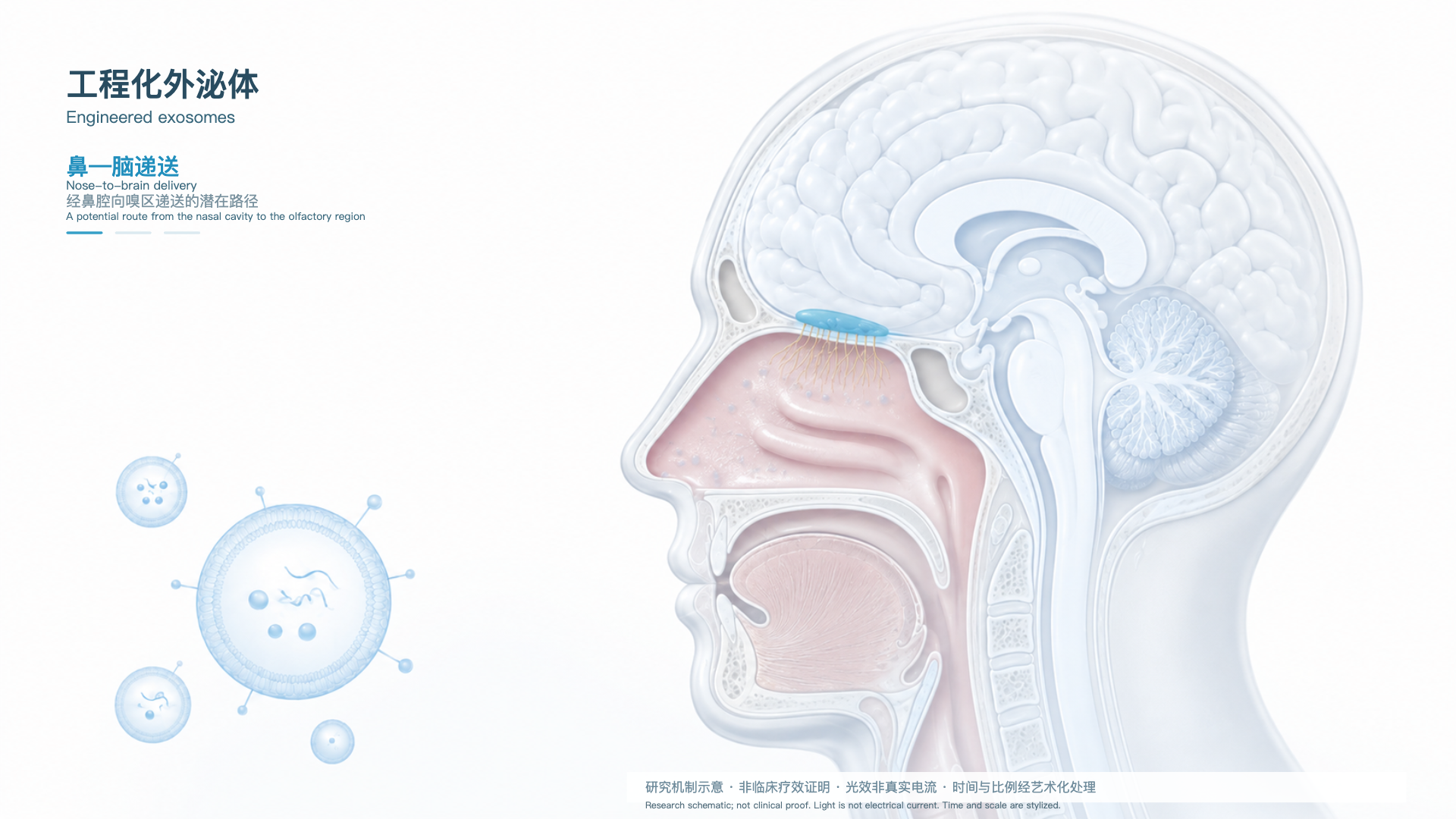
General research schematic, not a specific product or evidence of efficacy in humans. Scale, timing and particle counts are illustrative.
Nose-to-brain delivery
The nasal mucosa is the first barrier. Olfactory- and trigeminal-associated routes may contribute; clearance and systemic absorption also occur.
Exosomes are EVs of endosomal origin. This film uses extracellular vesicles (EVs) when that origin has not been established.
1. Nose-to-brain delivery
The nasal mucosa is the first barrier. Olfactory- and trigeminal-associated routes may contribute; clearance and systemic absorption also occur.
2. Distribution across multiple brain regions
Some animal studies detect signals in multiple brain regions. Distribution depends on the preparation and protocol, not proof of whole-brain delivery in humans.
3. Cellular uptake and cargo release
Vesicles can be internalized into endosomes. Uptake does not establish cytosolic cargo delivery or therapeutic benefit.
Spanning multiple rare genetic diseases — from mechanistic research to clinical translation, each program carries a family's hope.
Engineered exosomes are natural nanoscale extracellular vesicles that, after engineering modifications, can efficiently deliver therapeutic proteins and nucleic acids, with advantages including low immunogenicity and strong blood-brain barrier penetration.
Through surface engineering modifications, achieving targeted delivery to specific tissues and cells, improving therapeutic efficacy.
Exosomes are derived from the body's own cells, with extremely low immunogenicity and the ability to be administered repeatedly, reducing treatment risks and costs.
The same platform technology can be adapted for multiple rare disease genes — one process serving multiple conditions, accelerating the translation from research to clinic.